Showing posts with label relationships. Show all posts

Friday, 27 September 2013

The Trouble with Relationships ...

People often get together or marry believing that their partner will make them happy, give them confidence and make them feel as if they belong. Very often however, these relationships fail to prosper.
Imagine what happens if two people get together, both believing and hoping that their partner will provide this. If their preconceptions prove false, they may spiral into depression, get angry with each other and begin to drift apart.
Relationship issues
A dream come true?
The phrase ‘I don’t know what to do to make you happy’ is often heard in relationships and is sometimes said with increasing despair as the months or years pass by.
Where do our expectations come from?
Often the need for our partner to provide us with happiness, confidence, belonging, unconditional love and much more, comes from a lack of having felt this when we were very young. During the years when our emotional life develops, when our ideas of who we are and how we get our needs met is set as a basis of our personality, it is imperative that our caregivers are able to provide a stable and consistent, caring and loving environment.
Below are three basic examples of how expectations develop and the effects on our adult relationships and friendships:
  • If we don’t get the love and understanding in the first years of our life, we are likely to subconsciously search for this in other relationships and friendships only to get disappointed and have little if any trust in others. In reality we are searching for someone to provide us with a basis of who we are. Without this emotional basis, we are unlikely to have defined boundaries and will have an all or nothing kind of attitude to relationships; giving everything only for the next moment to retract ourselves completely. Often emotions we are unable to recognise become destructive, control us and result in us feeling isolated or excluded with perhaps anger or sadness being an overwhelming part of it. 
  • Having part of our emotional needs met in those very first years means we are more likely to be successful in love and able to cultivate balanced friendships. Although we may experience a level of caution when entering a new relationship or making new friendships, we have developed enough self-awareness to form a basis of who we are and boundaries will not be too troublesome (though may be movable by events and other people’s opinions). 
  • Of course if we have been lucky to have just the right amount of caring and attention we are likely to be well balanced individuals with a successful and happy life.  Boundaries will be well defined and our approach to relationships is one of sharing life, love and experiences, with a healthy self-contained attitude though also being inclusive and considerate to others. In this state we won’t be looking for others to provide us with a basis of who we are, because we know and are able to live our life from a well-established basis.
There is much more to the background of how our expectations originate and why, with many books having been written on the subject. Look up “attachment theory” with a search engine and lots will appear.
The possibility of change
If we belong to the first or, to some extent, the second category it would be very sad if we were unable to change - if we were deemed to go through life making the same ‘mistakes’ and having the same disappointments. 
As adults, establishing our own basis of who we are doesn't come from others, but from within ourselves. Emotions we may have tried to push away or are overwhelming, need to be recognised and cared for. The help is not in someone providing the love and care, but for someone to lead us to the tools we already have inside us: the capacity to love and care for ourselves.
Through self-nurturing or re-parenting ourselves, we can discover the parts we didn't get a chance to acquaint ourselves with when very young. Given the chance we are, with a little help, able to fulfill the longings of: ‘I want you to be kind to me, I want you to love me then everything will be ok’.
The journey to the point of being able to do this doesn't have to be long, but it will be emotional and it will hold a lot of discoveries, good and bad. It’s a journey worth travelling if we want to experience inner peace, outer joy and healthy balanced relationships.
Without knowing and practicing being kind to ourselves and loving ourselves, we will not be able to cultivate a truly loving, caring intimate relationship with another.  Without kindness and love for ourselves, we will not be able to accept the care and love offered by our partner.

Thursday, 27 December 2012

Christmas Contemplation


While going for a walk on Christmas day with my partner we began talking about how at this time of year we both think of events that have happened in the past year.  We spoke of feeling a little melancholic about not having certain loved ones with us, either because of distance or because they are no longer on this mortal earth.  We also talked about how life around us and within us has changed, some things for the better, some not so.  The analogy I used is that Christmas opens up past chapters in our lives, like a book revisited. But unlike a book, the chapters in our lives overlap and interlink with one another making it difficult to distinguish between them or even recognise when one has begun or ended.  Learning to recognise these chapters as a whole is important if we are ever to truly understand ourselves and the relationships around us.

Picture from https://www.facebook.com/WildforWildlifeandNature
These moments of contemplation give us a chance to re-assess the un-written words from our past and put the endings to chapters, perhaps so far not recognised, in their proper place.  I believe this process is important for us to honour events, positive or negative: celebrating or mourning gives us a chance to reach a feeling of closure.

Global Storytelling

At this time of year this process can be seen in other places of societal contexts: the newspapers produce endless summaries of the year past; the Queen’s speech telling us how brave and strong people have been; television and radio programmes all focussing on the experiences of the year past.  On a global scale it is important to remember the world’s events, big and small; this is after all what makes history.  As we all know the future of our culture and society is made up of the history we create in the present.

Personal Chapters

On a personal scale we tend to be not so willing to summarise our recent or indeed more distant past, thinking that dwelling on the past will not help us now.  However, just like culture and society our every present moment is creating our personal history and our every past experience will in some way affect our present moment.  Without having summarised and created relevant endings we will be leaving the chapters open.  We may even lack a conscious awareness of the existence of the whole chapters, which then leak together, becoming mixed up and undefined.

Being able to think about and put our lives in a clearly defined story line, with chapters that include a beginning, a middle and and an ending, will give us volume in our present lives, clarity in our thinking and a more peaceful, calm inner being.

Becoming Your Own Author

As we draw nearer to 2013, new chapters are waiting to be opened for all of us in the New Year.  We often do not know what they are.  An acceptance that events will happen is likely to put us in the author’s seat of our lives rather than letting life be the author with us as the main character being pushed from one role to the next.  We do this by embracing new experiences the best we can, knowing that this is another chapter beginning and remembering that these chapters will one day have an ending.

This Christmas my partner and I have had a quiet time which has given me a chance to re-write some of the chapters which needed editing a little.  Life’s past experiences never seem to be complete; as I gain more knowledge my perception of the past changes and I become the editor of the book of short and long chapters that have never been written down but are nonetheless very real.

I hope that new beginnings for you will bring you much joy.

Happy New Year!

Saturday, 24 November 2012

The Perfect Family Christmas


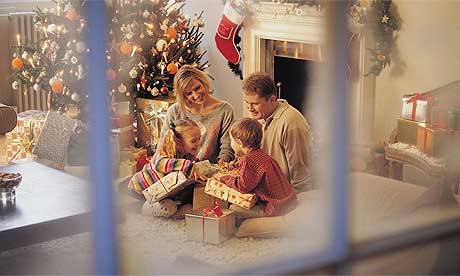
Christmas is knocking on our doors again with the promise of glad tidings and a festive season.  This time of year magazines, newspapers and your favourite websites are usually full of time saving suggestions, ideas for a homemade Christmas, stress reducing advice and a good look at your health with do’s and don’ts for the festive season.  Underneath it all lies the expectations often put on us by the family’s Christmas traditions.

Last year two of my client couples saw the pressure of the financial demands of Christmas collide with the worry of spending time negotiating the delicate equilibrium between family members.  Finding a new way of managing Christmas was not only high on their list of priorities but essential for their sanity to remain intact.

An Idyllic Christmas

Thinking aloud about the ideas of an ideal Christmas, we went straight to the amazing idyllic postcard scenario of the log cabin in the mountains; snow so deep it reached the roof and the bells jingling on the horse drawn sleigh. A pretty picture, and at a closer look what it really signified was the peace and joy they wished they could experience at Christmas.

It was this, peace and joy, we then worked with to create a realistic aim of a Christmas which could be enjoyed by all.  Initially looking at family traditions and expectations, what was important to whom and what the family rules were, gave us a good starting point.
Of course making changes to any of these were initially met with the dread of bigger family feuds or the fear of upsetting certain family members.  We began looking at different ways of introducing the new ideas, how they might be received by various family members and what could be said to make it easier for the whole family to receive the changes positively.

Change for Peace and Joy

It was interesting work and both couples came to very different solutions; Linda and Peter decided that they were going to introduce a cost limit on presents; one for adults and a little more for children.  As they weren't hosting Christmas they decided that they were going to shorten their stay with the family from the usual three days to just one night and have some time just for them and their children.

Because they had made the choice and worked together on what to say and how to approach the rest of the family with their decision, Linda and Peter felt in control of their own lives.  Their family accepted their decision saying that they had wondered about making changes themselves.  Linda and Peter had a wonderful Christmas and although it didn't snow, they had created a peaceful and joyous time very close to the postcard scenario we initially talked about.

A Bring and Share Christmas

Rose and Mike were the hosts of Christmas and traditionally would have to create two days of festive fun and food for the family, which usually consisted of ten people on Christmas day and up to 20 on Boxing Day.  Mike had been made redundant earlier in the year and had taken a job which paid half his previous salary.  They simply couldn't afford to put on the big spread that was expected.

After talking about what would work for them and coming up with some creative solutions, we together made sure that the message of change was delivered positively with as much encouragement as possible.  Their decision was to invite every member of the family to contribute an item of food from a list Rose and Mike had prepared and that this would be the present from the family to them.

With a little persuasion the idea went down really well and returning to counselling after Christmas they reported that it had been so successful the family had decided to take the idea on board as the new Christmas tradition.

If Christmas is stressing you out, there is always a solution.  Thinking creatively but realistically and putting the message across positively will often enable other family members to express their thoughts and need for change.

If you have ideas of wanting something different for Christmas, why not test them out on the most approachable member of your family?  You might be pleasantly surprised by the results.

Good luck!